

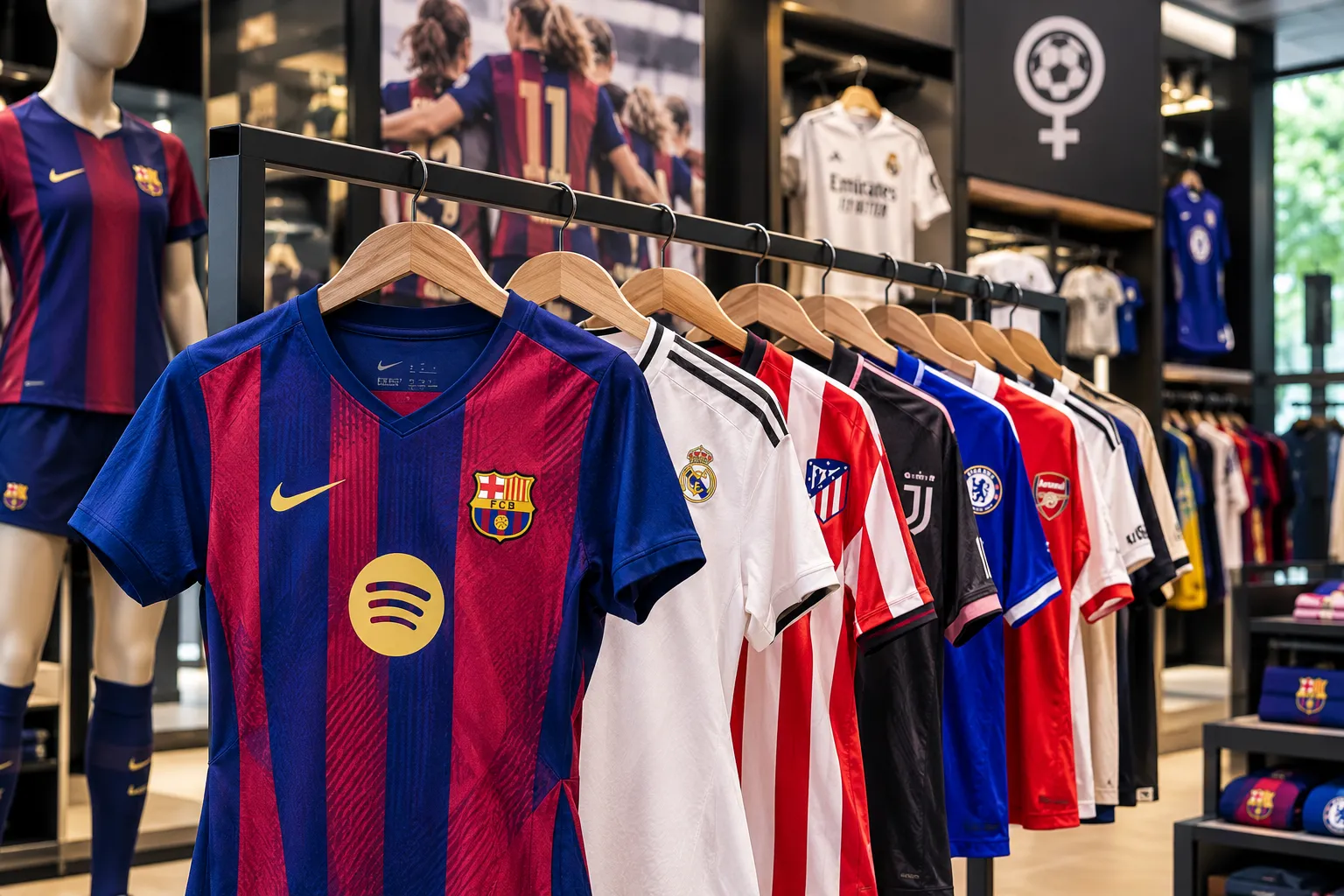
This is the part of the range that has changed fastest and is still described most confusingly. Walk into a club shop and you may be offered a women’s team shirt, a women’s-fit version of the men’s team shirt, or a unisex shirt in smaller sizes and the labelling frequently does not make clear which of the three you are looking at.
They are genuinely different products. Here is what each one is, how they fit, and which to buy.
Three different things, often badly labelled
The women’s team shirt is the kit the club’s women’s side actually plays in. It carries the same crest and usually the same base design as the men’s shirt, but the sponsor arrangement is sometimes different, and the competition sleeve patches are those of the women’s competitions rather than the men’s.
The women’s-fit replica is the men’s team shirt cut for a female body narrower at the shoulder, shaped through the waist, a slightly different neckline and sleeve length. Same team, same design, different pattern cutting.
The unisex shirt in a small size is simply the standard replica, made on a straight-cut pattern, in an XS or S. For years this was the only option a club shop offered, and for a lot of people it remains the preferred one.
A listing that says “women’s” might mean any of the three. In a shop the quickest way to resolve it is to look at the sleeve: women’s competition patches mean it is the women’s team shirt.
How do the three fits actually compare?
The women’s-fit replica is shaped rather than simply smaller. The shoulder seam sits further in, the body tapers at the waist and flares slightly at the hip, the sleeve is shorter, and the neck opening is usually a little wider and lower. For many people that is a better garment than a small unisex shirt, which is straight-sided and can be loose at the waist while tight across the chest.
But the shaped cut is less forgiving, and it is cut to one idea of a body shape. Plenty of people find the unisex pattern more comfortable precisely because it is not shaped, and prefer the longer body length. There is no correct answer, which is the argument for trying both and the argument for buying this particular item in a shop rather than online.
One practical note: women’s-fit ranges are frequently produced in a shorter size run than the unisex range, so the extremes at either end may not exist. If you are at the edges of the published sizes, the unisex shirt is more likely to have something that works.
Why did it take clubs so long?
Because the range was built on a forecast, and for years the forecast was wrong. Clubs stocked shirts according to what had sold before, which was overwhelmingly unisex, and read the resulting sales as evidence of what people wanted rather than as a consequence of what was offered.
What changed it was demand that could not be explained away sustained growth in attendance at women’s matches, international tournaments reaching audiences the club game had not, and a generation of supporters who wanted their own team’s shirt rather than a smaller version of someone else’s. Clubs responded, in most cases later than they should have.
The practical result today is that the range in a large club shop is reasonable and the range in a smaller one is still thin. If your club’s shop carries little, the broader market for womens football shirts is considerably better stocked than any single club’s shelf, particularly for the women’s team kits of other clubs.
How much the range differs between clubs
Enormously, and it tracks investment in the women’s side rather than the size of the men’s club. Some clubs now produce a full women’s team range with its own away and third shirts, a proper size run and the same product tiers as the men’s kit. Others stock one shirt in four sizes behind the till.
The pattern worth knowing is that the clubs furthest ahead are not always the biggest. A mid-table side that committed early to its women’s team often has a better range than a larger club that treated it as an afterthought, which is the opposite of what shoppers tend to assume.
If your club’s shelf is thin, the gap is usually filled online rather than in person, and that is the trade-off: better range, no chance to try the cut. Given the three patterns described above, that is a genuine cost rather than a minor inconvenience.
Printing, patches and the details
Printing works identically: official lettering, applied in the shop, specified typeface. The one thing to confirm is which squad you are printing a women’s team shirt should carry women’s squad numbers and names, and a shop that applies the men’s squad to it has made a mistake that cannot be undone.
Patches follow the competition. A women’s team shirt takes the patches for the competitions that team plays in, and putting men’s competition patches on it is wrong in the same way. Shops generally get this right; it is worth checking at the counter rather than afterwards.
What to buy
If you support the women’s team, buy the women’s team shirt it is the right shirt and it is the purchase that registers as demand for more of them. If you want the men’s team’s shirt in a shaped cut, buy the women’s-fit replica. If neither fit suits you, buy the unisex shirt in the size that fits and ignore the labelling entirely.
And buy it in person if you can. This is the single item in the whole range where three different patterns exist under similar names, and the only reliable way through that is to put two of them on. Our comparison of club shop and online pricing covers when it is worth paying the shop premium, and this is squarely one of those times. For the parts of the range that do go on sale, see when club shops discount football shirts.
One last practical note on timing: women’s team kit frequently launches on a different date from the men’s, sometimes weeks later, and goes into clearance on its own schedule. If you are waiting for a discount, the men’s kit calendar is not a reliable guide to it.
Frequently asked questions
What is the difference between a women’s team shirt and a women’s-fit shirt?## Frequently asked questions
What is the difference between a women’s team shirt and a women’s-fit shirt?
The women’s team shirt is the kit that team plays in, with its own sponsor arrangement and competition patches. A women’s-fit shirt is the men’s team shirt cut on a female pattern.
Is a women’s-fit shirt just a smaller version?
No. It is shaped narrower shoulder, tapered waist, shorter sleeve, different neckline. A small unisex shirt is straight-cut and simply smaller.
Which fits better?
It depends entirely on the wearer. The shaped cut suits many people and not everyone; the unisex pattern is longer and less fitted. Try both, which means buying in a shop.
Can a women’s team shirt be printed with any player?
It should be printed with that squad’s names and numbers, and carry that competition’s patches. Confirm this at the counter, because printing cannot be undone.