

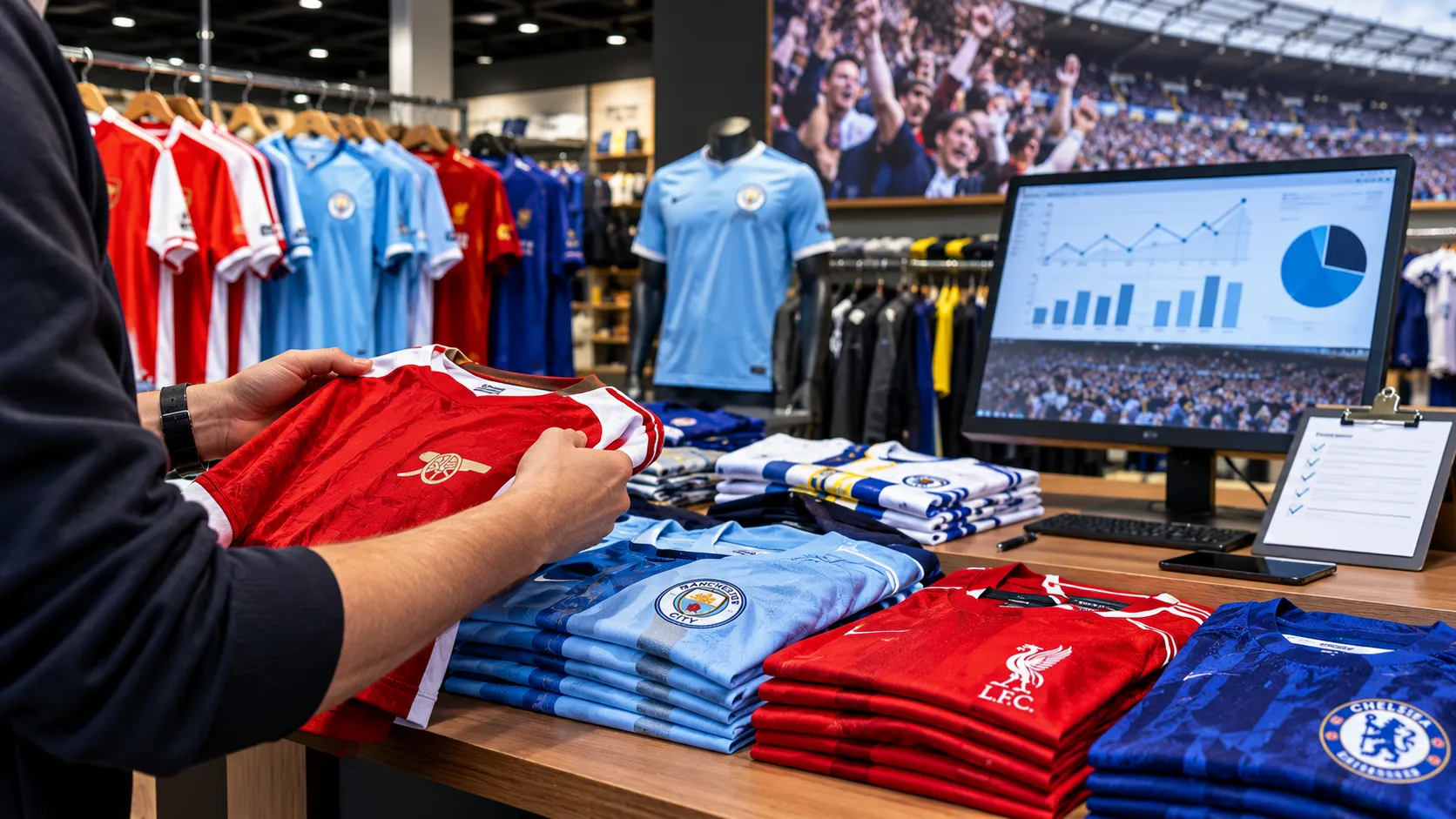
The question of how a club shop decides what to stock is settled far earlier than most supporters imagine. By the time a kit is on the rail, the decisions behind it are roughly a year old and largely irreversible.
That lag explains almost every frustration a shopper has with a club shop the missing size, the player name that is no longer at the club, the shirt that was never discounted because it sold out in a fortnight.
The ordering timeline
Kit orders are placed well in advance of the season, because manufacturing, shipping and distribution all take time and the supplier is producing for dozens of clubs simultaneously.
That means a club commits to quantities before the squad is finalised, before the previous season has ended in some cases, and long before anyone knows how the team will perform. The order is a forecast dressed up as a decision.
Reordering mid-season is possible and constrained. Supplier production runs are scheduled, so a club that sells out of mediums in September may wait months for more, or may not get them at all if the production window has closed.
Supplier minimums
The most important constraint and the least understood. Kit suppliers operate minimum order quantities, and those minimums apply per item and often per size.
For a large club this is irrelevant. For a smaller one it is the whole problem: the minimum order for a goalkeeper shirt in a particular size may exceed what the club will sell in two seasons, so the club either over-orders or does not stock it.
This is why smaller clubs’ ranges look thinner. It is not a lack of ambition; it is the arithmetic of a contract that was written for a bigger operation, and it affects every item from training kit to children’s ranges.
The size curve
Clubs order against a size distribution based on previous sales, and the curve is remarkably stable year to year. The middle sizes dominate, the extremes are thin, and the ratio between them barely moves.
What does move is the fit of the garment. A supplier that changes its cut between seasons slimmer, longer, differently proportioned invalidates the historic curve, and the club discovers this only once sales start.
That is the most common cause of an early sell-out in one size and a lingering surplus in another. The club ordered against last year’s fit and the shirt it received fits differently, which is why trying before buying matters more than a size label, as explained in buying kids football kit where the problem is most acute.
How are player names decided?
Carefully, and with an unavoidable risk. Printed shirts held as pre-made stock sell faster and generate more margin than printing on demand, so shops want them and every pre-printed shirt is a bet that the player will still be at the club.
The standard approach is to pre-print only the squad’s most saleable and least transferable players, and to print everyone else on demand. That is why the rail holds three or four names and the counter will do any of them.
When a bet goes wrong the stock is close to worthless. A shirt printed with a player who left in January cannot be sold at full price, cannot be reprinted, and goes to clearance at whatever it will fetch. The mechanics of the printing itself are covered in how shirt printing works at a club shop.
What about squad numbers?
A smaller version of the same bet, and one that goes wrong more often than names do. Numbers are printed as stock in the popular combinations, and a squad reshuffle in the summer can strand a quantity of shirts carrying a number nobody wants any more.
The complication is that numbers change without the player leaving. A player who moves from 24 to 8 after a good season makes the 24 shirts unsellable at full price and creates demand for 8 shirts the shop does not have, which is the worst of both outcomes.
Clubs that handle this well print numbers on demand alongside names and hold almost no pre-printed stock. It costs margin and removes the risk entirely, and it is why the counter can usually do any combination while the rail offers very few.
Beyond the kit
The non-kit range is where a shop has genuine discretion, and it is chosen on margin rather than passion. Scarves, mugs, keyrings and gift items carry far better margins than replica shirts, where the supplier takes a large share.
That is why the shop is laid out the way it is. Shirts bring people in and the margin sits elsewhere, so the high-margin items are positioned between the door and the kit.
Seasonal lines follow a calendar that has nothing to do with football. Gift ranges arrive in October for the Christmas trade, and a shop’s single biggest trading period is frequently December rather than August.
Why training kit is the other opportunity
The part of the range clubs order most conservatively, which makes it the part most likely to be discounted and least likely to be seen on anyone else.
Training ranges change annually like the kit but sell to a much smaller audience, so the order is cautious and the surplus proportionally larger. Training tops, quarter-zips and midlayers routinely reach clearance at a bigger reduction than replica shirts do.
They are also the better garments for ordinary use. A training midlayer is warmer, more durable and less conspicuous than a replica shirt, and it carries the crest just as clearly, which is why a lot of long-standing supporters own more of it than they do shirts.
The constraint is the same supplier-minimum problem described above, so at smaller clubs the training range may be two items and a hat. Where it exists in depth, it is the best value on the floor, and the item most likely still to be there at half price in March.
What a shopper should take from this
Buy early in the season if you care about size, because the middle sizes go first and may not return. Buy late if you care about price and can live with what is left.
Ask before buying a pre-printed shirt whether the player is under contract, which sounds cynical and saves money. A name printed on demand costs the same and carries no risk of becoming a curiosity in February.
If you end up with the wrong size anyway, the position on sending it back is set out in club shop returns and exchanges. And accept that a thin range at a smaller club is a contract problem rather than a choice. The alternative to a limited selection is frequently no selection at all, which is also what determines where surplus ends up the subject of what happens to unsold football shirts.
Frequently asked questions
How far ahead do clubs order kit?
Roughly a year. Quantities are committed before the squad is finalised and long before anyone knows how the season will go.
Why do small clubs have thinner ranges?
Supplier minimum order quantities. For a smaller club the minimum for an item may exceed two seasons of sales, so it is either over-ordered or not stocked.
Why does my size sell out so fast?
Because clubs order against a historic size curve, and a change in the supplier’s cut invalidates it. A slimmer fit shifts demand up a size and the order does not reflect that.
Why are only some player names pre-printed?
Pre-printed stock is a bet that the player stays. Shops pre-print only their most saleable, least transferable players and print the rest on demand.