

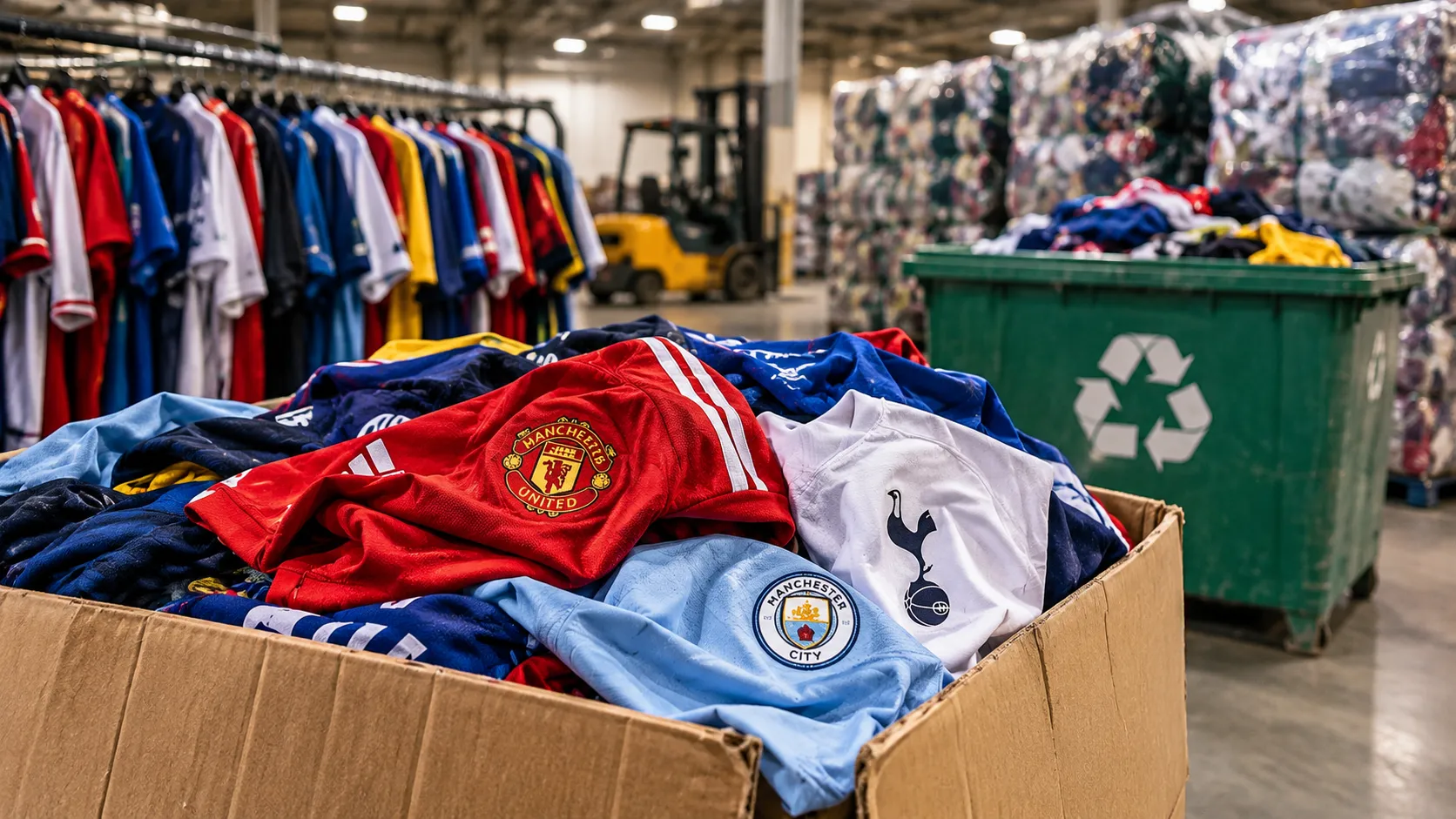
Every club over-orders, and the question of what happens to unsold football shirts has a longer answer than most people expect. A kit has a selling window of roughly a year, and whatever is left when the next one arrives has to go somewhere.
Where it goes depends on the club’s contract with its supplier, the size of the surplus, and how much the club cares about protecting the price of the new range.
Why there is always a surplus
Because ordering happens long before selling. A club commits to quantities months ahead of a kit launch, working from the previous season’s sales, expected squad changes and a guess about how the team will do.
All three can be wrong in the same direction. A side that was expected to challenge and finishes thirteenth sells considerably fewer shirts than the order assumed, and nothing can be done about it once the stock is in the warehouse.
Sizing adds a second layer. Clubs order a size distribution based on history, and the popular middle sizes sell out while the extremes sit. A surplus is rarely a surplus of shirts; it is usually a surplus of specific sizes, which is harder to shift.
Clearance in the club shop
The first and most visible route. Once the new kit launches, the previous season’s range moves to a discounted section, usually at a third to a half off, and stays there until it sells or until space is needed.
Clubs manage this carefully, because heavy discounting of last season’s shirt undermines the new one. The usual approach is a staged reduction rather than an immediate cut, with the deepest discounts arriving once the new kit’s launch period is over.
This is the best moment for a buyer and it is a narrow window. The sizes that remain are the ones nobody wanted, so the discount is real and the choice is limited, which is covered further in when club shops discount football shirts.
Outlet and third-party channels
What does not clear in the shop moves outward. Sports retail outlets, discount chains and online clearance operations buy end-of-line football stock in bulk, which is why a shirt that was forty-five pounds in November appears at fifteen the following autumn in a shop with no connection to the club.
This is contractual rather than casual. Supplier agreements specify where surplus stock can be sold and at what point, precisely so that it does not appear at a low price while the club is still trying to sell it at full.
The stock in these channels is genuine and the restrictions are the reason it looks odd mismatched sizes, change kits rather than home shirts, and occasionally shirts with the previous sponsor on a kit that was replaced mid-cycle.
Can you buy the surplus directly?
Sometimes, and the routes are worth knowing. A number of clubs run occasional warehouse sales, clearing old stock in a single weekend at prices well below the shop’s clearance rail, and these are advertised to mailing lists rather than publicly.
Signing up to the club’s retail newsletter is the only reliable way to hear about them, which is the one piece of practical advice in this article. The stock at these events is genuinely old several seasons back, in whatever sizes survived and the prices reflect that.
The other route is end-of-line listings on the club’s own online store, which are usually buried and rarely promoted. Clubs do not want to advertise cheap old kit next to the new range, so the clearance section is where you have to go looking.
What you will not get is a choice. Surplus is surplus, and by the time it reaches a warehouse sale it is the stock that three separate channels have already declined to buy.
Overseas distribution
Significant volumes of unsold football kit leave the market entirely, sold into territories where the club has no retail presence and where last season’s range is simply this season’s stock.
This is a legitimate and long-standing trade, and it is why you can find current-looking shirts of mid-table English clubs on sale in countries with no particular connection to them.
It is also where some of the confusion about authenticity comes from. A genuine shirt bought through an overseas clearance channel carries correct labelling and no retail history, which makes it look irregular to a buyer expecting a UK purchase trail.
Does any of it get destroyed?
Some, and less than it used to be. Branded stock that cannot be sold anywhere without damaging the brand was historically destroyed, and the practice attracted enough criticism across the clothing industry that most suppliers now have policies against it.
The current approach is usually de-branding or donation. Crests and sponsor marks are removed and the garment is recycled as material, or the stock is given to charitable distribution where the branding is not commercially sensitive.
What definitely gets destroyed is anything with an error a misprinted sponsor, a wrong crest, a batch that failed quality control. That stock cannot be sold at any price, because a licensing agreement does not permit selling something that misrepresents the club.
Where the retro market fits
Eventually, the surplus becomes the supply. Shirts that sat unsold for years, stored in warehouses and sold on in bulk, are a meaningful part of what circulates as retro football shirts two decades later unworn, with original labelling, in the sizes nobody wanted at the time.
That is why deadstock from the nineties still appears, usually in very large or very small sizes, and why it is often in better condition than you would expect of a thirty-year-old garment. It was never worn because it was never bought.
For a collector this is the good end of the market: genuine period stock, verifiable labelling, and no wear. The catch is the sizing, which is the same catch that stopped it selling originally. Older stock in club shops works the same way, as set out in the retro rail.
Why the change kits last longest
A consistent pattern in every club shop, and the reason is ordering rather than taste. Clubs order home shirts against reliable demand and change shirts against a guess, because away-kit sales depend heavily on whether the design happens to be liked.
A popular away kit sells out faster than the home shirt. An unpopular one sits for two years. There is no middle outcome, and nobody can predict which it will be until the kit is on sale.
For a buyer that is an opportunity. Change kits reach the deepest discounts, are least likely to be worn by everyone else at the ground, and are frequently the more interesting design of the two. Third kits go further still, because they are ordered in smaller quantities against even less certainty.
The only caution is longevity. A change kit usually has a one-season cycle while home shirts often run two, so a heavily discounted away shirt may already be two kits out of date rather than one.
What this means for buying
Buy last season’s kit immediately after the new one launches if you want the discount and your size still exists. Wait longer and the price falls further while the choice collapses.
Look at outlet channels a full year after a kit’s launch, which is when the bulk clearance reaches them. The shirts are genuine, the prices are the lowest they will ever be, and the selection is whatever is left.
And remember that the stock decisions behind all of this are made long before you see them, which is the subject of how a club shop decides what to stock.
Frequently asked questions
Why do clubs always have unsold shirts?
Because orders are placed months before the kit goes on sale, based on forecasts of sales, squad changes and league position. A surplus of specific sizes is near-inevitable.
Where does the surplus go?
Club shop clearance first, then outlet and discount retail, then overseas distribution into markets where the club has no retail presence.
Is clearance stock genuine?
Yes. Supplier contracts control when and where end-of-line stock can be sold, which is why it appears late and in odd size ranges rather than because it is irregular.
Is unsold kit destroyed?
Rarely now. Most suppliers de-brand and recycle or donate. Stock with errors wrong sponsor, misprinted crest is destroyed because it cannot be sold under a licensing agreement.