

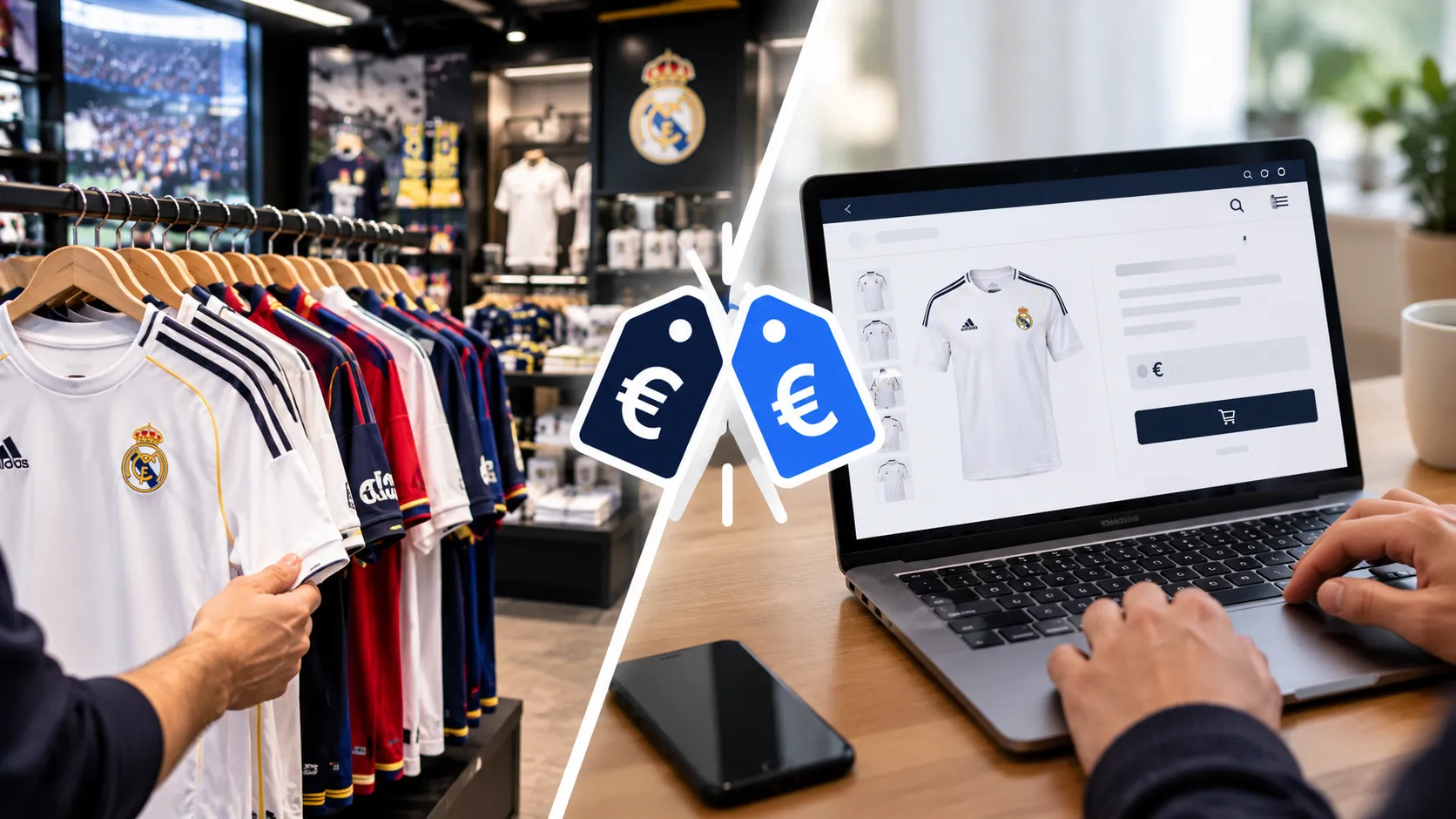
The honest answer is that online is cheaper on the shirt and the club shop is cheaper on the mistakes. Which of those matters more depends entirely on whether you know your size in that specific shirt, in that specific season, from that specific supplier and most people do not.
This is a straight comparison of the two, including the costs that only appear after you have decided, and the legal protections that differ between them in ways almost nobody realises.
The shirt itself
While a kit is current, the club shop sells at the supplier’s recommended price and cannot go below it. Online sellers are under no such constraint in practice: they discount against each other, run seasonal promotions, bundle delivery and clear stock early.
The gap is widest on alternative kits. Away and third shirts are produced in smaller runs, sell more slowly and start being discounted online around the turn of the year, while the club shop holds its price until the kit is formally out of cycle. By spring the same third shirt can differ by a third between the two.
On a mid-table club’s range the gap is narrower than at the biggest clubs, simply because fewer online sellers carry the stock. If you are after brighton shirts or anything from a club of similar size, there are fewer competing listings, which means less discounting and a smaller advantage to shopping around.
What gets added to the price after you decide?
This is where the comparison usually turns. A shirt is rarely just a shirt by the time you have paid.
Official name and number printing is an add-on in both channels, and it is applied in the shop while you wait or at the warehouse before dispatch. Competition sleeve patches are a separate licensed item and are also extra. Between them they can add a substantial proportion of the shirt’s price, and the charge is broadly similar wherever you buy.
Delivery is the online cost people forget, and returns postage is the one they forget twice. A shirt that is five pounds cheaper online stops being cheaper the moment you send it back at your own expense.
Which is cheaper once you include a wrong size?
The club shop, comfortably, and this is the strongest argument for it. Football shirt sizing is genuinely inconsistent between suppliers, between a club’s home and third shirt in the same season, and between the standard replica and the player version of the same design. The authentic version in particular runs at least a size small through the chest.
If you try the shirt on, that entire problem disappears. If you order online and guess, you are exposed to a return, which costs postage and time, or to keeping something that does not fit. Across a few purchases that evens out any saving the online price gave you.
The exception is when you already own the identical shirt in a known size. Then you are not guessing, and online wins on price without any risk attached.
The returns rights nobody mentions
Buying online in the UK gives you a right that buying in a shop does not. Under the distance selling rules, an online purchase generally carries a fourteen-day right to cancel and return the item for a refund, whether or not anything is wrong with it. An in-store purchase carries no such right at all a shop only has to refund you if the goods are faulty, not if you simply changed your mind. Any in-store returns policy beyond that is a goodwill gesture the shop chooses to offer.
There is a significant exception, and it bites on exactly the thing football shoppers buy. Personalised goods are generally excluded from the right to cancel, so once a shirt has a name and number printed on it, that fourteen-day protection is gone. Citizens Advice sets out the detail.
The practical rule that follows: order the shirt plain, confirm it fits, and have the printing done afterwards. Doing it in that order keeps your right to return the garment and costs you nothing extra.
What about the club’s own online store?
Worth separating out, because it is a third channel and behaves like neither of the others. Most clubs run an official webstore alongside the physical shop, and while a kit is current it is priced the same as the counter same supplier recommendation, same constraint.
Where it differs is stock and rights. The webstore draws on a central warehouse rather than the shop’s own shelves, so it frequently has sizes the shop has run out of, and it carries the full range rather than what fits on the floor. And because it is a distance purchase, it comes with the fourteen-day right to cancel that the shop counter does not.
That makes it the sensible middle option for a lot of purchases: official stock, full size run, proper printing, and a return right if the fit is wrong. The one thing it cannot give you is the fit confirmed before you commit, which remains the shop’s single real advantage.
One cost that applies to neither channel but catches people anyway: buying abroad. A shirt ordered from outside the UK can arrive with import duty and a handling fee attached, which is frequently larger than the saving that prompted the order. Check where a seller actually ships from before comparing its price to anything.
Where each one genuinely wins
Online wins on price for current kit at big clubs, on last season’s stock, and on the whole alternative-kit range after January. It also wins when you know your exact size and need no advice.
The shop wins on fit, on anything printed, on anything signed or occasion-specific, and on immediacy. It also wins on advice, which is worth more than people credit staff who handle the range daily know which shirts run small and which seasons were cut differently.
The approach that costs least overall is to use both: try the size in the shop, buy the plain garment wherever it is cheapest, and come back for the printing. More on that in how shirt printing works at a club shop.
Frequently asked questions
Can I return a football shirt bought in a club shop if it does not fit?
Not as a right. Shops only have to refund faulty goods; a change of mind is at their discretion. Online purchases are different and generally carry a fourteen-day right to cancel.
Does the right to return apply to a printed shirt?
Generally no. Personalised goods are excluded from the right to cancel, so printing a name and number removes that protection. Buy plain, check the fit, then print.
Is the club shop price ever lower than online?
On current kit, rarely, because the retail price is set while the design is in cycle. On exclusive, signed or occasion-specific stock the shop is the only option.
Are patches and printing cheaper online?
Broadly the same, because both are licensed items with controlled pricing. The difference is that the shop applies printing while you wait and lets you check the fit first.