

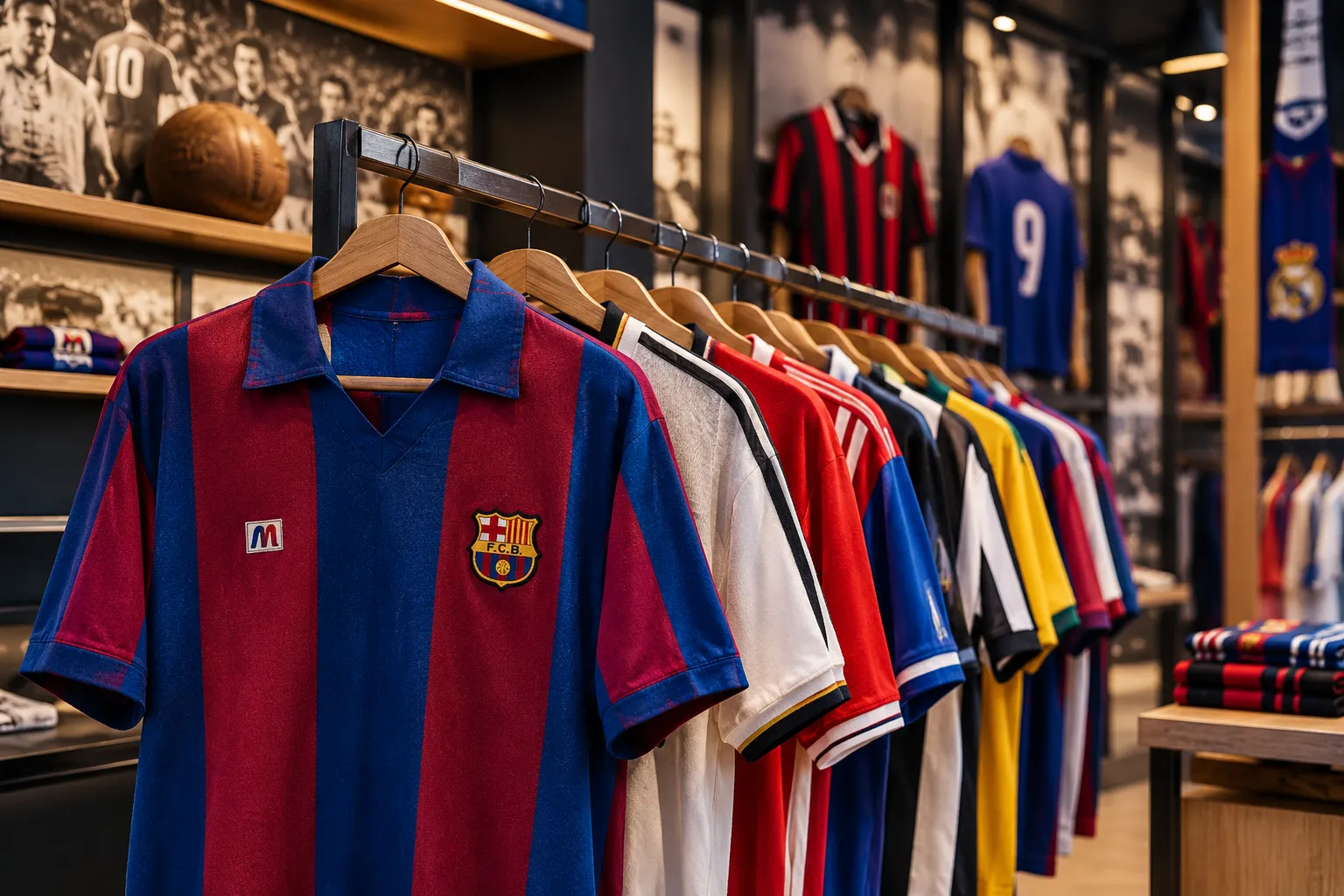
Twenty years ago a club shop sold this season’s kit and nothing else. Now most of them carry a retro rail officially licensed reproductions of shirts from the seventies, eighties and nineties, sold alongside the current range at a similar or higher price.
It is one of the more interesting developments in football retail, and it has created a genuine confusion for buyers, because three quite different products are all described as “retro” and only one of them is what most people think they are getting.
What are the three things that all get called retro?
The first is a licensed reproduction. The club has authorised a manufacturer to remake a specific season’s shirt, with the correct crest, the correct sponsor where the sponsor has agreed, and a cut based on the original. This is what a club shop sells, and it is the only version that carries the club’s official backing.
The second is an original from the period an actual shirt made and sold at the time, now decades old. These are traded between collectors rather than sold in shops, and condition drives the price far more than the design does.
The third is a tribute shirt: correct colours, correct era, correct pattern, but no crest, no sponsor and no supplier branding. These are entirely legal, often very well made, and considerably cheaper, because the maker is competing on fabric and construction rather than on a badge.
None of the three is better than the others. They answer different questions. The confusion only causes harm when a listing implies one and delivers another.
What makes a good reproduction
The same four details every time: the badge, the collar, the number font and the fabric weight. Those are the expensive parts of getting a period shirt right and the first things a cheap version simplifies.
On a well-made reproduction the crest is embroidered with clean edges and the fine detail inside it stays distinct at arm’s length. The collar is the specific construction that season used a wide pointed collar, a buttoned placket, a ribbed crew rather than a generic modern neck. The lettering matches the era’s typeface. And the fabric feels substantial, with a visible weave, because original shirts were made from heavier material than anything produced today.
A reproduction that feels like a current shirt is a modern blank with an old design printed on it. That is not a fault if it is what you wanted, but it is not a reproduction of anything.
Which eras hold their value?
Broadly, the ones attached to something. A shirt from a season a club won something, or from the era its current identity was established, holds value in a way a shirt from a mid-table season never does regardless of which is the better design.
Clubs whose colours changed at some point are the interesting exception, because the shirt from the change itself becomes the collectable one. The all-white era is the obvious example, and demand for leeds united retro shirts from the period when that identity was set runs well ahead of demand for seasons either side of it, for reasons that have nothing to do with results.
The other reliable driver is scarcity of the original. Where a club has never licensed a reproduction of a particular season, originals from it command a premium simply because there is no alternative supply.
Sizing, which catches everyone
Retro cuts are boxier through the body and shorter in the sleeve than modern shirts, because that is how shirts were made. A faithful reproduction in your usual size will feel wider and shorter than you expect, and that is correct rather than wrong.
Measure a shirt you already own flat across the chest, armpit to armpit, and compare that figure against the seller’s measurements rather than trusting the size letter. If you are buying in a shop, try it on and ignore the label entirely which is the one genuine advantage a club shop has over every online retro seller.
Should you buy retro from the club or a specialist?
From the club if you want the licensed version and the certainty that comes with it; from a specialist if you care more about how the shirt is made than whose crest is on the paperwork.
The club’s reproduction is authorised, so the crest and usually the sponsor are correct and the product is what it claims to be. The trade-off is that clubs licence a limited set of seasons the obvious ones and the construction is whatever the licensee chose to do.
A good specialist, by contrast, often builds a better garment: heavier fabric, correct collar construction, period-accurate cut, because that is the whole basis on which it competes. What it cannot legally include is the crest. For a lot of buyers that is a fair exchange, and for others it misses the entire point.
One caution either way: a seller who offers to add a club badge to a tribute shirt is selling a counterfeit, whatever the listing says. The crest is the licensed element, and adding it is the line. If the range you want is a smaller or less represented part of the market, the same logic applies as for women’s football shirts in club shops the club’s own shelf is rarely the whole picture.
Why club shops bothered
Because the retro rail solves a problem the current range cannot. A club shop’s addressable market is limited by how many people want this season’s shirt, and that number is finite and already well served. A retro range reaches people who stopped buying current kit years ago, people buying for a birthday, and people who want the shirt from the season they first went.
It also carries a far better margin than current replica kit, for the reasons set out in our piece on what a club shop actually sells the price is not pinned to a supplier’s recommended figure, because the kit is long out of cycle.
For a buyer that cuts both ways. The margin means the rail will not be discounted, so there is no point waiting for a sale. But it also means the range keeps growing, because it works. More on the parts of the range that do get discounted in when club shops discount football shirts.
Frequently asked questions
Are club shop retro shirts original or reproductions?
Reproductions. They are newly manufactured under licence from the club, based on a specific season’s design. Genuine originals from the period are traded between collectors, not stocked in shops.
What is a tribute shirt?
A period-style shirt with the correct colours and pattern but no crest, sponsor or supplier branding. They are legal, often well made and cheaper, because the maker pays no licence fee.
Do retro shirts fit the same as modern ones?
No. They are cut wider through the body and shorter in the sleeve, following the original shape. Buy on chest measurement rather than the size label.
Do club shops discount their retro range?
Rarely. Retro kit is long out of cycle, so there is no pricing constraint and no clearance pressure. The rail tends to hold its price indefinitely.