

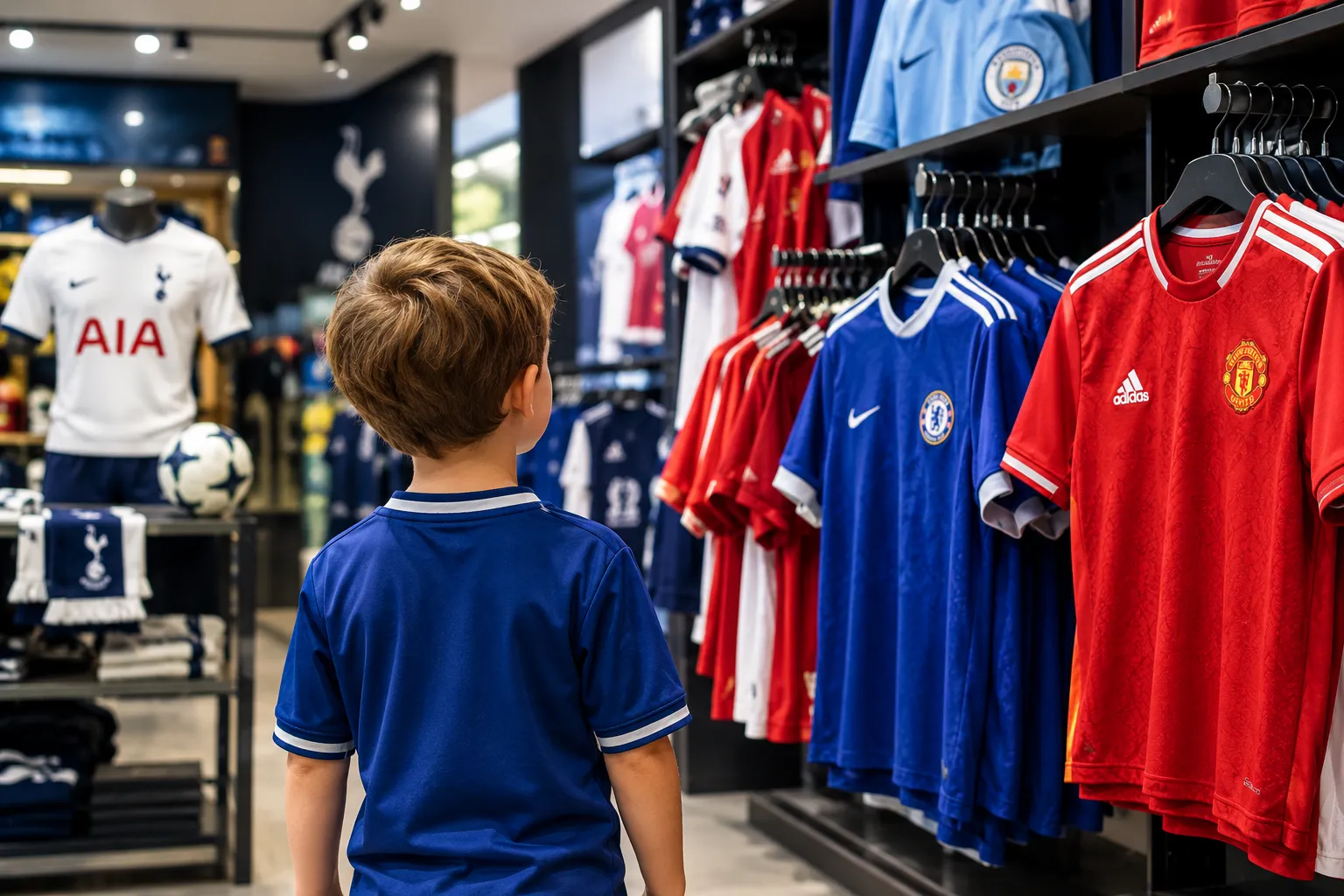
Buying a child’s kit is the one purchase where the club shop earns its premium outright. Children’s sizing is the least consistent thing in football retail, the consequences of getting it wrong are immediate, and the only reliable way to solve it is to put the shirt on the child and look.
This is what to check, what the labels actually mean, and where the money is worth spending.
Age labels mean almost nothing
Children’s kit is sold by age five to six years, seven to eight, and so on and those labels vary enormously. Between suppliers the same nominal age can differ by several centimetres across the chest. Between a club’s home and third shirt in the same season it can differ again. And children of the same age differ by far more than either.
What to use instead is the chest measurement, which most suppliers publish alongside the age and which is the only number that means anything. Measure the child across the chest, under the arms, and compare. If a retailer publishes no measurements at all, that is a reason to buy somewhere that does.
In a shop you can skip all of this by trying it on, which is the entire argument for buying a child’s kit in person.
How much growing room should you buy?
One size up, not two. A shirt one size too big is worn for two seasons; a shirt two sizes too big is worn for none, because a child will not wear something that hangs off them, and by the time it fits the design is out of date and a friend has the new one.
Shorts tolerate more growing room than shirts, because the waist is usually elasticated and adjustable. Socks tolerate the least a sock that is too big slides down inside a shin pad all game and is the single most common cause of a child wanting to come off.
If you are between sizes and the child is in a growth spurt, size up on the shirt and buy the shorts to fit now. Shorts are the cheapest item in the set to replace.
What is worth paying for and what is not
Worth it: a properly fitting shirt, decent socks, and shin pads that match the sock size. Socks are the item where cheap genuinely means worse a good playing sock has a cushioned foot, a thinner leg to sit inside a pad, and a ribbed calf that holds without digging in.
Not worth it: a player-version or authentic shirt for a child, which is cut for an adult athlete and is less comfortable, and a full kit set when the child only wants the shirt. Most children wear the shirt constantly and the shorts twice.
The standard replica is the right product here. It is cut generously, made from one durable fabric, and survives the washing machine far better than the premium versions. Across a range of kids football shirts the entry-level replica is not a compromise for a child it is the correct choice.
Should you print a child’s shirt?
Usually with their own name rather than a player’s, and the reason is straightforward: the player will leave and the child will not. A shirt with a child’s own name and chosen number stays meaningful for as long as they want to wear it, and it is the version they are proudest of.
The practical cautions are the same as for adults, with one addition. Printing removes any right to return the shirt, and children’s sizing is where returns are most often needed so confirm the fit absolutely before anything goes near a press. Buy it, take it home, let them wear it around the house for an evening, then go back for the printing.
How often will a child actually need a new one?
More often than the kit cycle, which is the uncomfortable part. A child in a growth spurt can move through two sizes in a year, while clubs release a new home shirt every season so the honest answer is that most children need a new shirt roughly annually, and it will rarely be the same design twice.
That argues for spending less per shirt rather than more. The standard replica at entry price, bought one size up, worn for two seasons if the growth allows, is the sensible pattern. An authentic shirt for a child who will outgrow it before the sponsor changes is money spent on the wrong thing.
It also argues for considering a season behind. Last season’s shirt costs a fraction of the current one, and a child who was not following the club a year ago does not know or care which season it is. The exception is the child who very much does know, in which case the current shirt is the only acceptable answer and you knew that already.
For older shirts generally, the club shop’s own retro range is a separate proposition covered in the retro rail.
The matchday problem
A club shop on a matchday is the worst possible place to buy a child’s kit. The queue is long, the size run has been picked over, the staff have no time to measure anyone, and the child is excited and will agree that anything fits.
Go on a quiet weekday instead. The full size run is on the rail, somebody can measure properly, and there is time to try two sizes. If it has to be a matchday, go well before kick-off rather than at half time, and know the chest measurement before you walk in.
Shorts, socks and the rest of the set
The shirt gets the attention and the socks cause the problems. A playing sock needs a cushioned foot, a thinner leg so it fits inside a shin pad, and a ribbed calf that holds without digging in and the cheap versions are uniformly thin, which means no cushioning under the studs and a sock that slides down all game.
Shorts are the most forgiving item: elasticated waists tolerate growing room, and they are cheap enough to replace mid-season. Shin pads need to match the sock size rather than the child’s age, and a pad that is too long is the most common reason a child stops wearing them.
If the budget is fixed, spend it in this order: shirt that fits, decent socks, pads that match, shorts last.
Frequently asked questions
How much bigger should I buy a child’s football shirt?
One size up at most. Two sizes up means it does not get worn now and is out of date by the time it fits.
Are age labels on kids’ kit reliable?
No. They vary significantly between suppliers and even between shirts from the same club in one season. Buy on the published chest measurement.
Is a player-version shirt suitable for a child?
No. It is cut for an adult athlete, runs small, and is less comfortable for everyday wear. The standard replica is the better product.
Should I buy the full kit or just the shirt?
Just the shirt, unless the child plays in it. Most children wear the shirt constantly and the shorts rarely, and shorts are cheap to add later.