

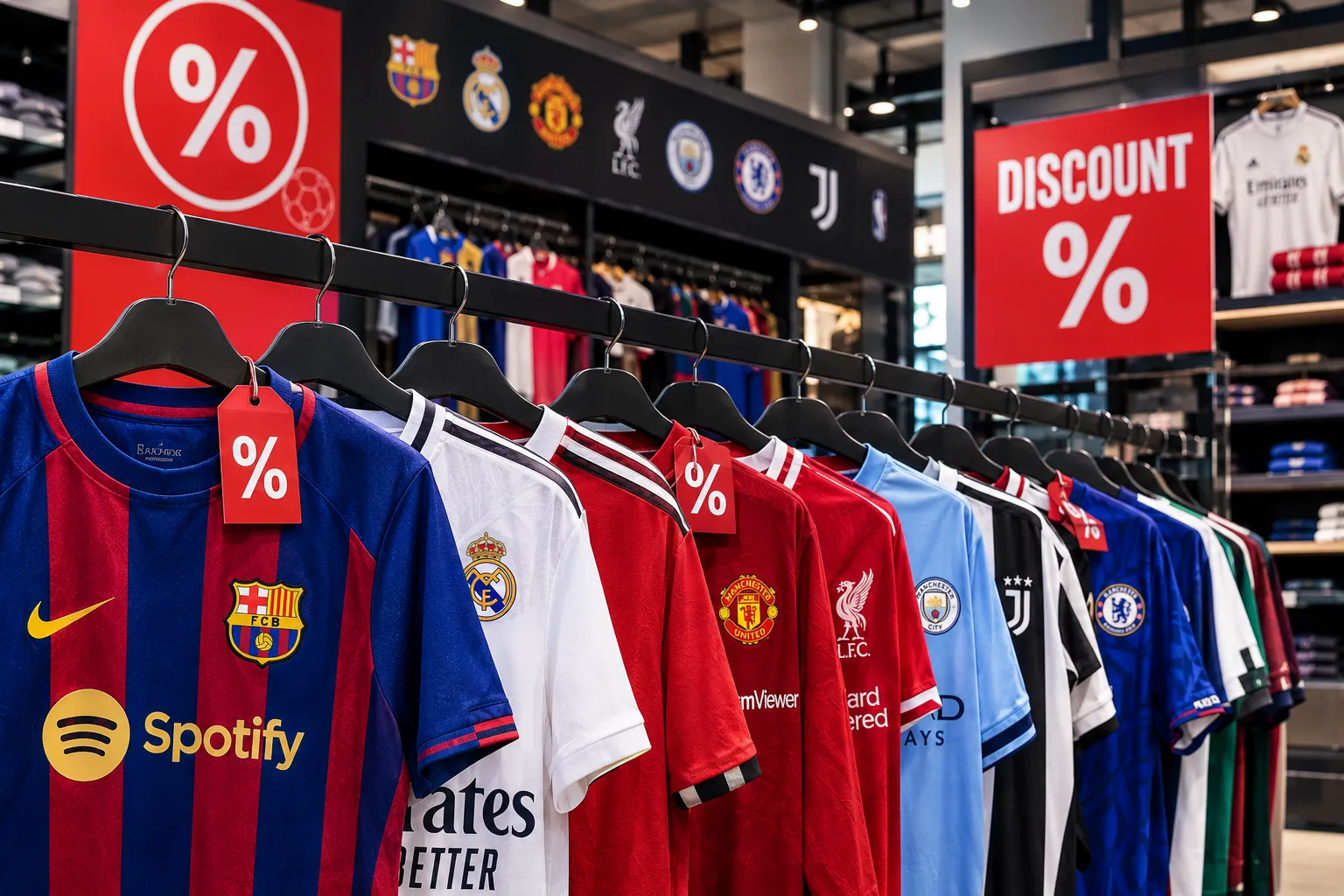
When Club Shops Discount Football Shirts
A club shop does not choose when to put shirts on sale. For most of the year it cannot, and understanding why turns an unpredictable-looking sale rail into a calendar you can plan a purchase around.
The rule underneath all of it is simple: while a kit is current, the price is effectively fixed. Everything about when and what a shop discounts follows from when each part of the range stops being current.
The release calendar sets everything
Most clubs follow the same sequence. The home shirt launches in the weeks before the season starts and is the anchor of the range. The away shirt follows within a month or so. The third shirt arrives a month or two into the campaign, often timed to a European competition.
That staggering is deliberate three retail moments instead of one and it means the three shirts leave the cycle at different points too. The third shirt, launched last, is the one with the shortest selling window and the largest over-order risk, which is why it is almost always the first thing discounted.
Kits now generally run for a single season rather than two, which has doubled the number of launches and, usefully for a buyer, doubled the number of clearance events.
When do the prices actually move?
The turn of the year. The first real discounting, and it falls on the alternative kits. Away and third shirts that were over-ordered get marked down once the Christmas trade is finished, typically in January. The home shirt does not move.
Spring, once the next season’s kit is announced. This is the big one. The moment a club confirms next season’s home shirt, the current one stops being the thing people want, and the shop is free to clear it. Discounts deepen through the weeks that follow.
The weeks after the new kit goes on sale. The deepest cuts of the year, because the shop now needs the floor space and the old stock has no future. If price is your only concern, this is the moment.
Between those three points, very little happens. A shop may run a short promotion around Boxing Day or a cup run, but the structural discounting is tied to the cycle, not to the retail calendar.
What a sale price actually tells you
A markdown is information, and it is worth reading rather than just taking. A shirt discounted early and heavily was over-ordered, which usually means it was unpopular on release and unpopular designs stay unpopular, so it will still be cheap in six months and will hold no resale value at all.
A shirt discounted late and modestly sold well. The shop is clearing the last of it rather than escaping a mistake, and that is the one to buy if you want something that will still look good in five years.
The signal is clearest on third shirts, which attract the strongest reactions in both directions. A third kit that is half price in November told you everything about how it landed. One that is still near full price in April, with only odd sizes left, was the design people actually wanted.
None of which matters if you simply like the shirt. But if you are buying with any thought to keeping it, the timing of the discount is a more honest guide than any review.
What never goes on sale
Four categories, reliably. Retro reproductions, because they are long out of cycle and under no pricing constraint there is no clearance pressure on a shirt from 1992. Signed and match-related stock, which is unique and priced accordingly. Occasion-specific items produced in a single run for an anniversary or a final. And printing, patches and personalisation, which are services at a licensed price rather than stock to be cleared.
This is worth knowing because it changes the strategy. Waiting for a sale on a current replica shirt is sensible; waiting for a sale on a retro shirt is waiting forever. Demand for newcastle united retro shirts and the equivalent ranges at other clubs is steady year-round and entirely detached from the kit cycle, so the price you see in October is the price in June.
Why is the sale rail always the wrong size?
Because stock is ordered on a forecast made months before anyone saw the design, and the forecast is wrong in a predictable direction: too many at the extremes, not enough in the middle. The sizes that sell first are the ones most people wear, so by the time a shirt is discounted the remaining stock is disproportionately the smallest and largest.
There is no way around this other than timing. If you need a common size and you want the discount, buy at the first markdown rather than waiting for the deepest one the extra saving is usually smaller than the risk of the size disappearing. If you take an unusual size, wait as long as you like; the stock will still be there.
Does the same cycle apply online?
Roughly, but earlier and more aggressively. Online sellers are not holding a single club’s stock on a shop floor, so they begin discounting an alternative kit as soon as it stops moving rather than waiting for the cycle to formally turn. That is why an away shirt can be twenty per cent down online in November while the club shop is still at full price.
The deepest online cuts arrive at the same moment as the shop’s when the following season’s kit lands but they go further, because an online seller has no reason to protect the brand’s price positioning in the way a club does. The counterpart is that the size run online disappears faster, since the stock is being drawn down by a national market rather than a local one.
So the practical split is this: if you want an alternative kit at a discount and you are flexible on timing, watch online from January. If you want it in a specific size, buy at the first markdown wherever you see it. And if you want a current home shirt, no channel is cheaper than any other until spring.
How to actually time it
Three straightforward rules. If you want the current home shirt and you want it now, there is no cheaper moment than any other buy it and stop thinking about it. If you want the current home shirt and can wait, buy it in the weeks after next season’s is announced. If you want an alternative kit, January is the first good moment and spring is the best.
And if the shirt is a gift for a specific date, buy early at full price rather than gambling on a sale arriving in time with the right size in it. The whole range and how it is put together is covered in what a football club shop actually sells.
Frequently asked questions
When is the cheapest time to buy a football shirt?
The weeks immediately after the following season’s home kit is announced, usually in late spring. Alternative kits start falling earlier, around January.
Why does the home shirt never get discounted during the season?
Because the retail price is effectively fixed by the kit supplier while the design is current. The shop cannot cut it until the kit leaves the cycle.
Do retro shirts ever go on sale?
Very rarely. They are already out of cycle, so there is no clearance pressure and no pricing constraint. Their price tends to hold year-round.
Should I wait for the deepest discount?
Only if you take an unusual size. Common sizes sell out at the first markdown, and the extra saving from waiting is usually smaller than the risk of losing the size.