

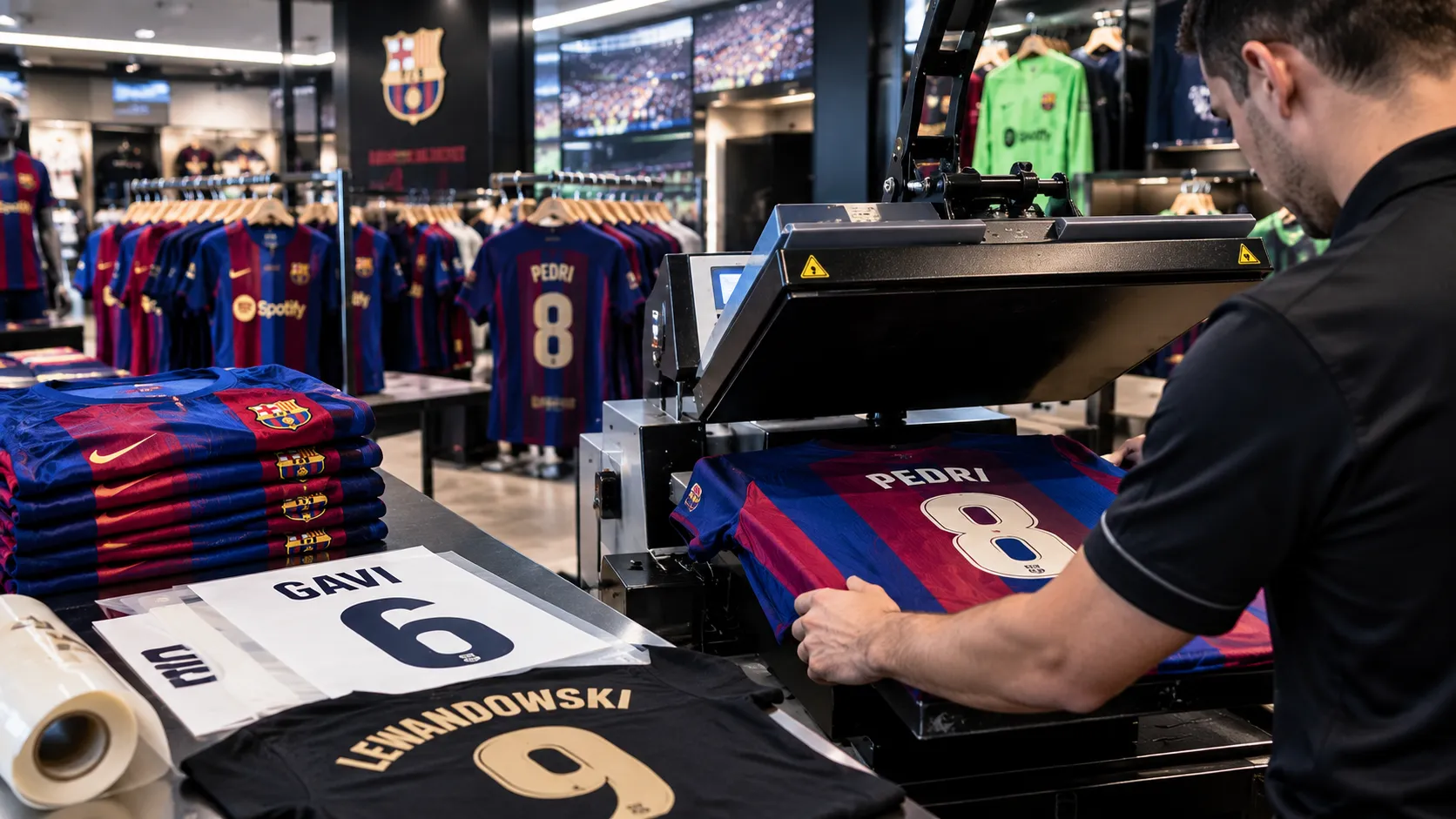
The printing desk is the least understood part of a club shop and the one with the most rules attached. You hand over a shirt and a name, somebody feeds it through a press, and four minutes later it is permanent. What happens in those four minutes is tightly licensed, and the reasons it costs what it costs are not obvious.
It is also the one decision in the whole purchase that cannot be undone, which makes it worth understanding before you reach the counter.
Why is the lettering licensed rather than chosen?
A club shop cannot print whatever font it likes. Each competition specifies an official typeface for names and numbers, produced under licence by an approved supplier, and the shop buys the lettering as a physical product sheets of pre-cut or cuttable material in the correct typeface, colour and size.
That is why the price is what it is. The shop is not charging for four minutes of labour; it is charging for a licensed consumable plus the right to apply it. It is also why the font changes when a club changes competition, and why a shirt printed for a European campaign looks different from the same shirt printed for a league season.
The sizing is specified too. Character height, the gap between the name and the number, and the position on the back are all defined, which is why properly printed shirts from the same season look identical and home-made ones never quite do.
How the application actually works
Heat and pressure. The lettering is positioned on the shirt, covered with a protective sheet, and pressed at a set temperature for a set number of seconds. The adhesive on the back of the material melts into the fabric and bonds as it cools.
Getting it right is more skilled than it looks. Too cool or too brief and the letters lift at the edges within a few washes. Too hot or too long and the shirt’s fabric is damaged synthetics scorch, and a shadow of the press plate can be left permanently on the garment. The press also has to be aligned by eye against the shirt’s own seams, because a number that is two centimetres off centre is obvious forever.
This is the argument for having it done at the shop rather than anywhere cheaper. The consumable is the same; the person operating the press is not.
Why can a printed shirt not be returned?
Because personalisation makes it unsaleable to anyone else, and the law recognises that. Goods made or modified to a customer’s specification are generally excluded from the normal right to cancel a distance purchase, and in-store there was never a right to change your mind in the first place.
So the moment the press closes, the shirt is yours in every circumstance except a genuine fault. If the printing itself is defective wrong name, crooked, lifting immediately that is a fault and the shop should put it right. If it fits badly, that is not.
The order of operations matters enormously here, and it is the single most useful thing in this article: buy the shirt, take it home, try it on, wash it once if you want to, and only then have it printed. Nothing is lost by waiting and a great deal is protected.
Can you get printing done anywhere else?
You can, and it is usually a mistake. Independent print shops and online sellers will apply names and numbers for less, but they are rarely working with licensed lettering in the competition’s official typeface and the difference is obvious to anyone who has seen the real thing.
The giveaways are consistent: a font that is close but slightly too narrow or too rounded, character heights that do not match the specification, a name positioned too high or too low relative to the number, and vinyl thick enough to feel as a raised plastic layer rather than sitting almost flush with the fabric. That thicker material is also the first thing to crack at the edges.
There is a legitimate exception. Where a shirt is years out of cycle and the official lettering for that season is no longer produced, a specialist reproducing a period font is doing the only thing available, and the good ones do it well. For anything current, use the shop. For a child’s shirt in particular, where the name may be their own rather than a player’s, the official route is the one worth paying for see buying kids’ football kit at the club shop.
What to print, and what people regret
Two regrets dominate. The first is printing a current player’s name, which ages badly a shirt with a name that left in the next window becomes a specific kind of souvenir. The second is printing a name on a shirt that was never going to fit.
The alternatives that age well are a squad number with no name, a name of your own, or nothing at all. A plain shirt is also the most versatile thing in the range: it works for any season, suits any occasion, and is the only version that holds its resale value.
If you do want a player, the ones worth printing are the ones who are not going anywhere a long-serving captain, an academy graduate on a long contract, a player whose association with the club is already permanent.
One more practical point: have the printing done on a shirt that has already been washed once if you can. A new technical shirt can carry a residue from manufacturing that affects how well the adhesive bonds, and a single cool wash removes it. Shops will not insist on this and most prints are fine either way, but it costs nothing.
Looking after printing once it is on
Printing fails from heat, not from wear. Wash the shirt inside out at thirty degrees with a liquid detergent, skip the fabric conditioner, and air dry it away from radiators and direct sun. Never put an iron directly on the lettering, and never tumble dry a printed shirt.
If a corner does start to lift, stop washing it and deal with it: a low-heat iron pressed firmly through a tea towel will often re-bond the adhesive. Each wash after a lift begins takes more of it away, so catching it early is the difference between a repair and a ruined shirt.
Frequently asked questions
Can I take my own shirt to a club shop to be printed?
Usually yes, provided it is a genuine current or recent shirt in a condition the press can handle. Shops generally will not print a counterfeit and may decline a very old or damaged garment.
Why does official printing cost so much?
The lettering is a licensed product in a specified typeface, bought in by the shop as a consumable. The charge covers that licence and the application, not just the time.
Can printing be removed?
Not cleanly. Heat-applied lettering can sometimes be lifted by a specialist, but it usually leaves a visible mark where the adhesive bonded. Treat printing as permanent.
Should I print before or after checking the fit?
Always after. Printing removes any right to return the shirt, so confirm the fit on a plain garment first.