

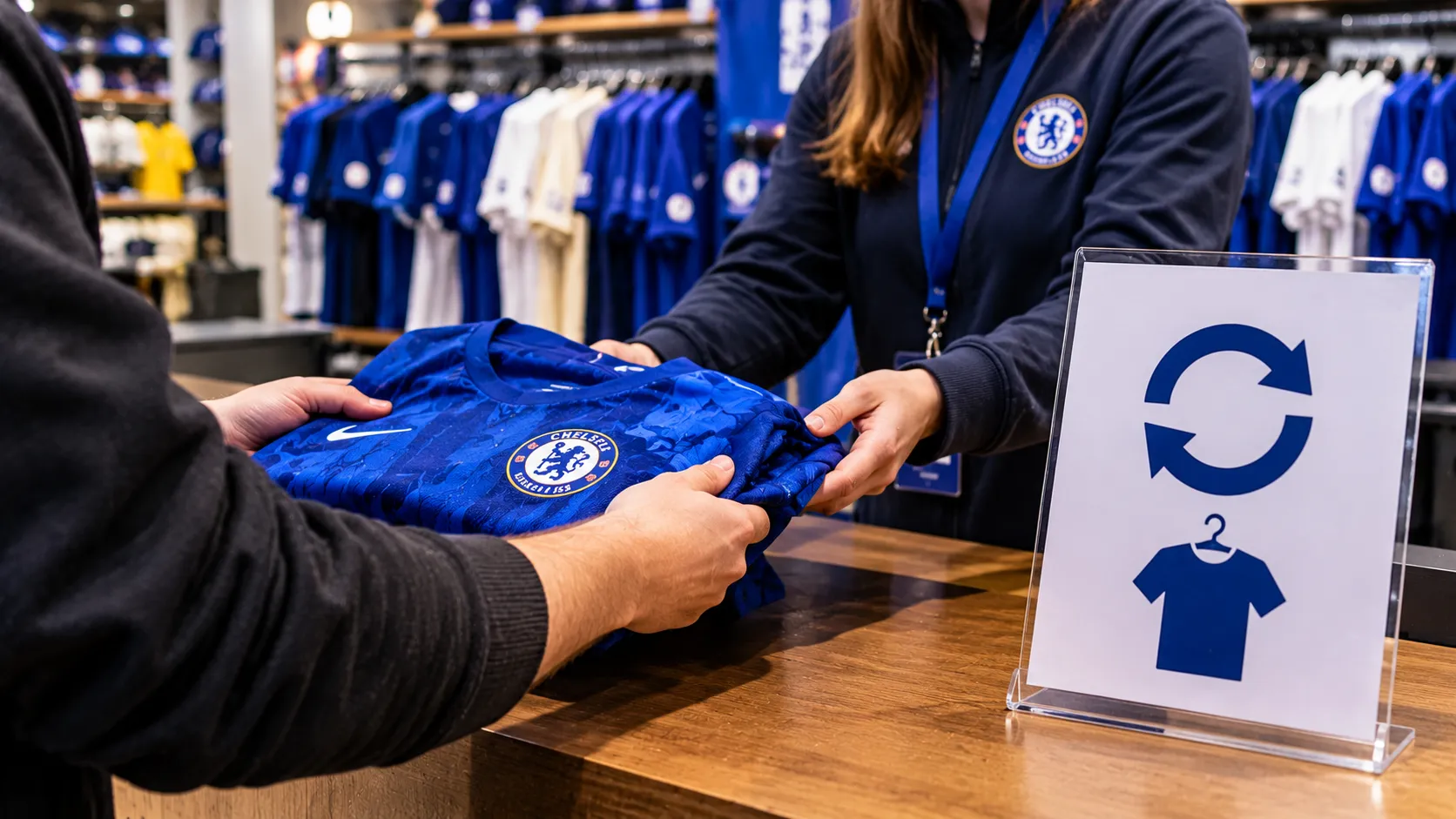
Club shop returns and exchanges cause more arguments at the counter than anything else, almost always because the shopper and the staff member are talking about two different things. One is thinking about statutory rights; the other is applying a store policy.
Both are legitimate and they cover different ground, and knowing which applies to your situation resolves most disputes before they start.
Statutory rights versus store policy
Your legal position covers goods that are faulty, not as described, or unfit for purpose. In those cases you have rights regardless of what any sign in the shop says, and a store policy cannot remove them.
Store policy covers everything else changing your mind, buying the wrong size, deciding you do not like it. There is no general legal right to return a non-faulty item bought in a physical shop, and whatever the club offers in that situation is a goodwill policy rather than an obligation.
Citizens Advice sets out the statutory position in detail, and the practical summary is that the distinction between “faulty” and “I changed my mind” determines everything that follows.
Why online purchases are different
Because distance selling rules give you a cancellation period for goods bought without seeing them, which does not apply to a purchase made in a shop.
That means the same shirt bought online and in the club shop carries different return rights, which is counterintuitive and frequently the source of the argument. A shopper who bought online and then visits the shop to return it may also find the shop cannot process an online return at all, because the two operate as separate businesses with separate stock systems.
Check before travelling. Many clubs do accept online returns in store and a meaningful number do not, and the answer is usually on the club’s own returns page rather than anywhere obvious.
Printed shirts
The important exception and the one that catches most people. A shirt printed with a name and number has been personalised to your order, and personalised goods are generally excluded from cancellation rights.
That exclusion is legitimate and it is not unlimited. If the printing is wrong wrong name, wrong number, wrong font, poorly applied the item is faulty or not as described, and your statutory rights apply in full regardless of the personalisation.
The practical consequence is that you should check the printing before leaving the counter. A spelling error noticed in the shop is fixed immediately; the same error noticed at home becomes a conversation about whether it was there when you left.
What can a club refuse?
Quite a lot, legitimately. Items without proof of purchase, items worn or washed, items outside the policy window, and personalised items that are not faulty.
What it cannot refuse is a genuinely faulty item within a reasonable period. A seam that fails after three wears, printing that lifts after one wash, a crest that comes away these are quality failures and the retailer is responsible for them, not the manufacturer and not you.
The common misunderstanding is about who you deal with. Your contract is with the shop that sold you the shirt, so a club directing you to the kit supplier for a manufacturing fault is giving you the wrong answer, however politely.
Gifts and the receipt problem
A substantial share of club shop returns are gifts, and gifts arrive without the thing that makes a return straightforward.
Most clubs will exchange an unworn, tagged item without a receipt if it is clearly current-season stock, because they can see what it is and what it sold for. What they will not do is refund to cash, because there is no record of what was paid, and that is a reasonable position rather than an obstructive one.
The fix is a gift receipt, which almost every club shop will issue on request and almost nobody asks for. It records the purchase without the price, which is exactly what a gift needs.
If you are receiving rather than buying, ask for the size before the shirt is printed. A plain shirt in the wrong size is an exchange; a printed shirt in the wrong size is a conversation with no good outcome.
How to make it go smoothly
Keep the receipt and the tags, which between them resolve most disputes without discussion. A digital receipt sent to an email address you can find on your phone is better than a paper one in a drawer.
Go back soon. Rights for faulty goods do not expire quickly, and store policies for unwanted goods often expire in a fortnight, and nobody at the counter can tell which category you are in before you explain it.
And be specific about the problem. “It is faulty” invites a debate; “the printing has lifted after one cold wash, here is the care label I followed” does not. The quality markers worth checking at the point of purchase are covered in club shop or online.
How do you avoid the problem entirely?
Try the shirt on. Replica fits change between suppliers and between seasons, and the five minutes in a fitting room removes the most common reason for a return.
Delay the printing. Buy the shirt, wear it once, and come back for the name and number it costs the same and converts a non-returnable personalised item into a returnable plain one until you are certain.
And buy early if size matters, because the exchange you want depends on the shop still having the alternative size, which it frequently does not by October and once it has gone to clearance it follows the route described in what happens to unsold football shirts. Why that happens is explained in how a club shop decides what to stock.
Faulty after a few months
The grey area where most genuine disputes sit, and the rule is more generous than people assume. Statutory rights for faulty goods are not limited to a fortnight; a shirt that fails in a way it should not have failed is the retailer’s responsibility for a meaningful period after purchase.
What is reasonable depends on the item and the price. A replica shirt is not expected to last a decade, and it is expected to survive a season of ordinary wear and washing according to the care label. Printing that lifts, seams that open and crests that detach within that period are quality failures rather than wear.
The practical difficulty is evidence. Keep the care label, follow it, and photograph the fault when you notice it rather than after you have tried to fix it. A shirt that has been ironed over lifted printing is a shirt whose history has become arguable.
If the shop declines and you believe the item was faulty, the escalation route is the club’s customer services rather than the counter. The person on the till applies policy; the person who can depart from it is elsewhere.
Frequently asked questions
Can I return a shirt because it does not fit?
Only if the club’s policy allows it. There is no general legal right to return a non-faulty item bought in a physical shop that is goodwill, not obligation.
Are online purchases treated differently?
Yes. Distance selling rules give a cancellation period for goods bought without seeing them, which does not apply to in-store purchases.
Can I return a printed shirt?
Not if you simply changed your mind, because personalised goods are excluded from cancellation rights. If the printing is wrong or poorly applied, your statutory rights apply in full.
Who is responsible for a manufacturing fault?
The shop that sold it to you, not the kit supplier. Your contract is with the retailer.