

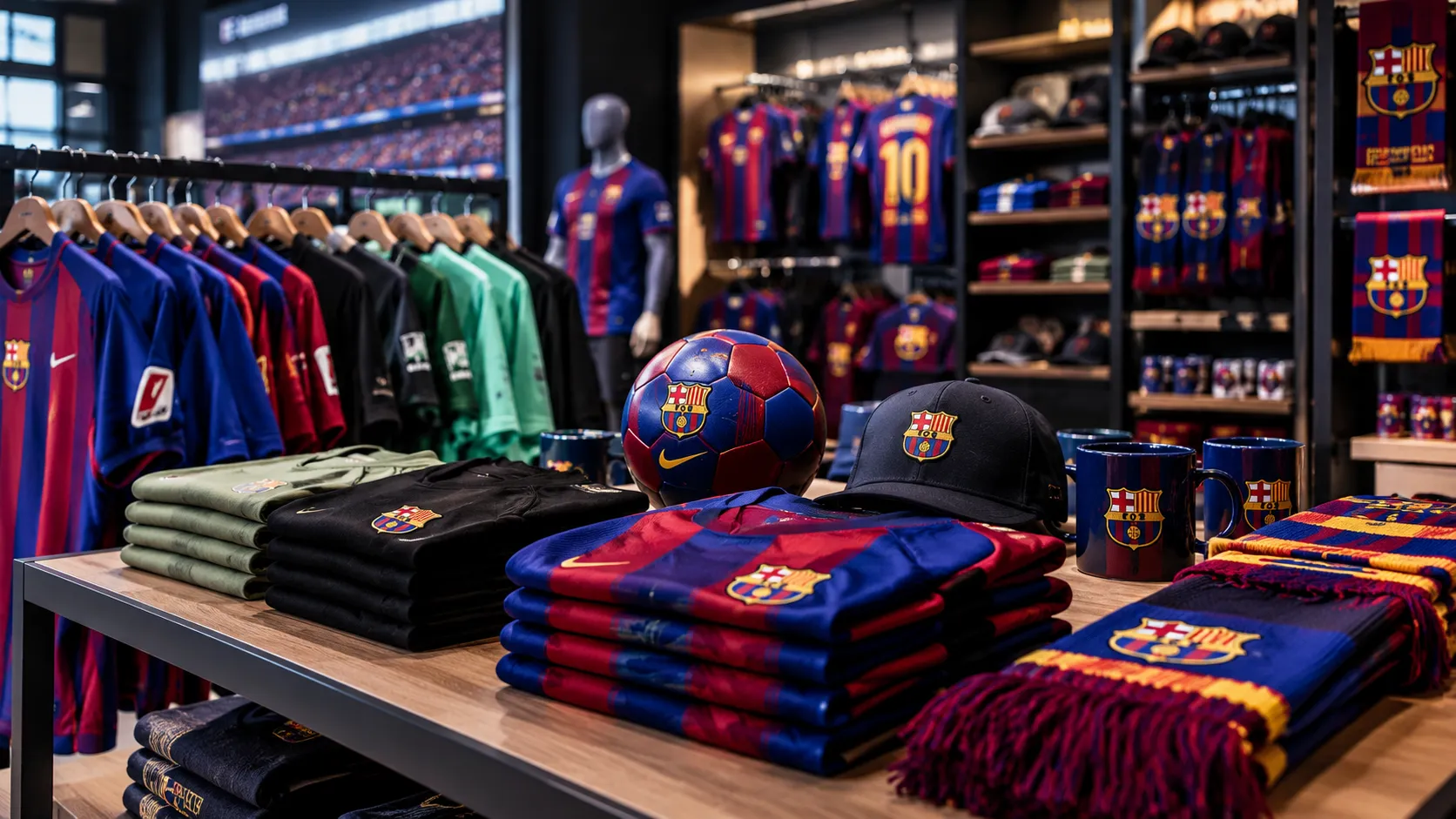
A club shop looks like the simplest retail operation in the country. It sells shirts, it is busy for four hours a fortnight, and it has a captive market with no competition inside a mile. In practice it is an odd and quite constrained business, most of which is decided by people who do not work for the club.
Understanding how one is put together changes how you shop in it. Some of what sits on those shelves is genuinely exclusive and will never be discounted; some of it is identical to stock you could order for less from your phone while standing in the queue.
Who actually owns the product
Very little of a club shop is made by the club. The replica kit belongs to a licensing arrangement with the kit supplier, who designs and manufactures it, pays the club a fee for the right to do so, and sets a recommended retail price. The club buys stock from the supplier at wholesale and sells it on.
Almost everything else scarves, mugs, keyrings, bedding, stationery, novelty items comes from a different set of licensees altogether. A company applies for the right to put a club’s crest on a product category, pays a royalty, manufactures it, and sells it to the club and to other retailers. That is why the quality of club merchandise varies so wildly within a single shop: the scarf and the keyring have nothing to do with one another beyond the badge.
The practical upshot is that the shop has less control over its own range than you would assume. A club cannot simply decide to sell a better mug; it can only choose from what its licensees produce.
What does a club shop actually make money on?
Not the shirt, mostly. Replica kit is the reason people walk in and the thinnest margin in the building, because the wholesale price is set by the supplier and the retail price is effectively fixed while a kit is current.
Where a shop makes its money is everything attached to the shirt and everything bought on impulse. Name and number printing is the clearest example it carries a far better margin than the garment it goes on. So do sleeve patches, scarves, hats, and the entire gift category. A shop whose window is full of shirts is earning its keep from the things people add at the till.
That shapes the layout. Kit is at the back, which is why you walk past everything else to reach it, and the printing desk is positioned where the queue for it is visible from the door.
What is genuinely exclusive
Three things, broadly. First, anything personalised: printing applied in the shop with the official lettering is the shop’s own service and cannot be bought in from elsewhere. Second, signed and match-related stock, which comes from the club directly and exists nowhere else. Third, the small run of items made for a specific occasion an anniversary, a final, a stand opening which is produced once and never reprinted.
Everything else is likely to be available elsewhere, often cheaper. Current replica kit in particular is sold by the supplier’s own stores, by sports retailers and online, and the club shop has no pricing advantage on it at all.
Is a club shop more expensive than buying online?
On current kit, usually yes, and not because the club is profiteering. The shop has a fixed retail price set by the supplier for as long as the kit is current, while online sellers discount against each other, run promotions and clear last season’s stock aggressively. The shop simply cannot move.
Where the shop wins is on the things you cannot get online: trying a size on, having printing applied properly, and buying something today rather than in four days. We go into the price comparison properly in club shop or online: which is cheaper for football shirts.
Why is the shop busiest at exactly the wrong time?
Because a club shop’s trade is concentrated into a few hours a fortnight, and that is also the window in which it can serve people worst. Ninety minutes before kick-off there is a queue at the till, a longer one at the printing desk, and the size run on the rail has been picked through by everyone who arrived earlier.
The staffing cannot fix it. A shop that employed enough people for a matchday rush would be carrying that wage bill through five quiet days a week, so matchday is handled by temporary staff who know the till but not the stock. The person who can tell you that the third shirt runs small is working Tuesday.
There is also a stock problem specific to the day. Deliveries arrive midweek, so by the time a Saturday crowd arrives the shelves reflect whatever last week’s crowd left behind. If you want the full range and somebody to help you through it, the worst possible time to walk in is the time almost everybody does.
What happens to stock that does not sell
It waits. A club shop cannot return unsold replica kit to the supplier, so a design that was over-ordered sits until it can be discounted, which is not permitted until the kit is out of cycle. That is the entire explanation for the end-of-season clearance rail: it is not a promotion, it is the first moment the shop is allowed to cut the price.
Sizes are the other half of it. Stock is ordered on a forecast made months ahead, and the forecast is always wrong in the same direction — too many extremes, not enough mediums and larges. By February a clearance rail is mostly extra-small and triple-XL, which is why patient shoppers get the price and impatient ones get the size.
What to buy in the shop and what to buy elsewhere
Buy in the shop: anything that needs to fit, anything that needs printing, anything signed or occasion-specific, and anything you want in your hands before you leave. Buy elsewhere: current replica kit if price is your priority, last season’s kit, and anything from the gift category that a licensee also sells through ordinary retailers.
And one thing worth knowing: the shop is a different place on a non-matchday. No queue, staff with time to measure you properly, and the full size run still on the rail rather than picked over. If you are buying something that matters, go on a Tuesday.
Frequently asked questions
Do clubs make most of their kit money from the club shop?
No. For most clubs the supplier’s licensing fee is the dominant kit-related income and it is agreed in advance, so shirt volume mainly benefits the manufacturer. The shop’s own profit comes largely from printing, accessories and gifts.
Why is the club shop never cheaper on current shirts?
Because the retail price is effectively set by the kit supplier while a design is current. The shop has no room to discount until the kit goes out of cycle.
Is club shop merchandise better quality than other retailers’?
Not necessarily. Non-kit merchandise is made by licensees who also supply other retailers, so the same scarf or mug is often available elsewhere at a different price.
When is the best time to visit a club shop?
A midweek non-matchday. The size run is intact, the printing desk has no queue, and staff have time to measure you rather than process you.